
I came across an interesting webpage featuring two photographs from an old scroll titled Takagi-ryū Toribō (Takagi-ryū Cane/Staff Techniques) from 1816.
The author is somewhat skeptical about the historical claims surrounding Kukishin-ryū and Takagi-ryū, but I’m not here to debate that. I simply found the content fascinating and thought it might be of interest to fellow Bujinkan practitioners.
I was surprised to learn that Takagi-ryū includes dedicated cane (jō/toribō) techniques. The scroll itself is quite unique, especially the description of the unusual staff with eye-shaped holes and an inserted tantō.
Note: I only translated parts of the website and the makimono to the best of my knowledge, so the translation may contain some errors or inaccuracies.
If any of you have access to the complete makimono or more information about these techniques, I’d love to see it!
Below is the translated text from the website.
The moon points and knocks at the gate — tiles slip and lose their alignment.
Silent and formless, without outward manifestation, those who try to explain it are like darkness.
A faint lamp in the night — all is emptiness.
Reaching that point, how subtle it is! How dynamic it is!
It cannot be fully revealed. In short, I have conveyed its true essence.
高木流捕棒序 Takagi-ryū Toribō
Now, there exists a certain transmission scroll. Its title is Takagi-ryū Toribō (Takagi-ryū Cane/Staff Techniques), published in the 13th year of the Bunka era (1816). The lineage of successors recorded at the end of the scroll is as follows:
大国八九郎 Ōkuni Hachikurō
大国太郎太夫 Ōkuni Tarōdayū
大国武右衛門 Ōkuni Takeuemon (and so on)
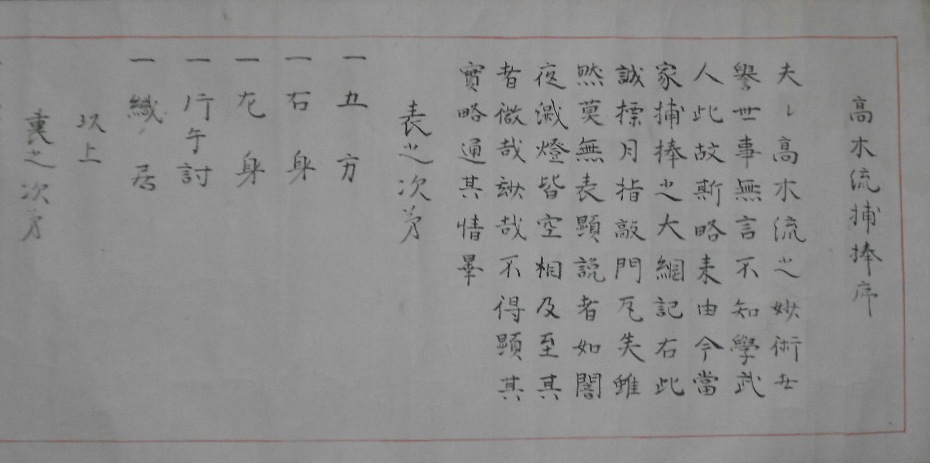
Preface to Takagi-ryū Toribō (Cane / Staff Techniques)
There is no one who would say that the wondrous techniques of Takagi-ryū are not profound. Nevertheless, because of this, people seek new interpretations. Therefore, I now record the great outline of our school’s cane techniques.
Truly: The moon points and knocks at the gate — tiles slip and lose their alignment. Silent and formless, without outward manifestation, those who try to explain it are like darkness. A faint lamp in the night — all is emptiness. Reaching that point, how subtle it is! How dynamic it is! It cannot be fully revealed. In short, I have conveyed its true essence.
Omote no Tsuji (Outer Sequence)
- Go Hō (Five Directions)
- Migi Mi (Right Body)
- Hidari Mi (Left Body)
- Gyōgo Tō (Moving Attack / Marching Attack)
- Shoku Kun (Weaving Sovereign / Wrapping Lord)
Ijō (End)
裏之次序 Ura no Tsuji (Inner Sequence)
高木流捕棒序
夫-高水流之炊所女
寒世事無言不知學式
人此故斯略表由今當
家捕捧之大組記右此
誠標月指敲門瓦失維
然莫無表頸說者如閣
夜微燈皆空相及至其
者微哉动哉不得頸其
宽略通其情畢
表之次汤
一 五 方
一 右 身
一 左 身
一 行午討
一 織 君
以上
裏之次汤
Toribō Description
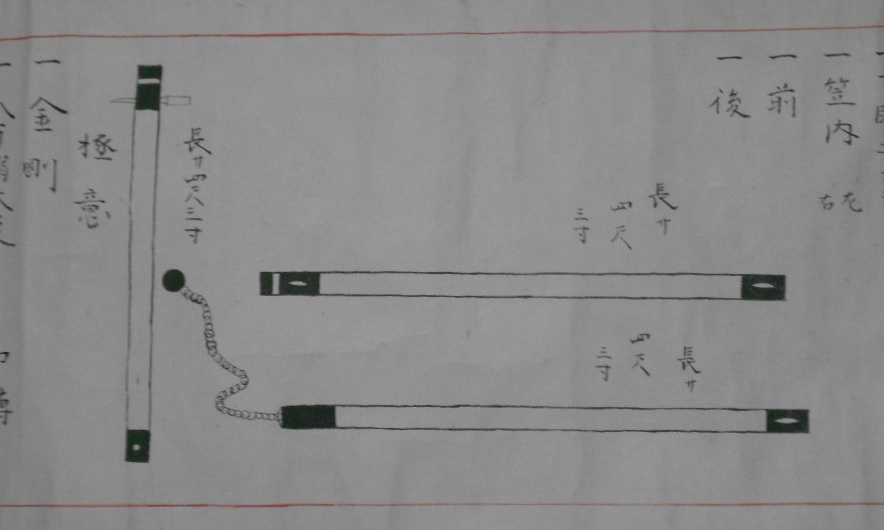
一笠内
一前
一後
長サ 長サ
四尺 四尺
三寸 三寸
長サ四二八二一寸
極意
一金則
Ikkanai (One inside the hat / One within the cover)
Ippen (One forward)
Ichigo (One rear)
Length Length
Four shaku (approx. 129.7 cm)
Three sun
Length: 4 shaku 2 sun 8 bu 2 rin 1 sun (approx. 129.7 cm)
Gokui (Secret Principle)
Ikkinoku (One Golden Rule)
