
Jinchū Kyūsho ranks among the most frequently documented Kyūsho points in classical Japanese martial arts. People know it as 人中 Jinchū (“Center of the Human”). It appears across numerous Koryū traditions as a precise target in the facial region. Study of this point forms part of the larger system of 当身 Atemi (“Striking the Body”) and 殺活 Satsukatsu (“Killing and Reviving”) methods. Old transmission documents preserve these methods.
This essay is mostly gathered from the book 当身殺活術の極意 Atemi Satsukatsujutsu no Gokui written by 小佐野 Jun Osano, supplemented with my own experience of Bujinkan training and its nine schools/ryuha. In Bujinkan we often refer to the Kyūsho points from Kotō-ryū.
What Is Jinchū Kyūsho and Where Is It Located?
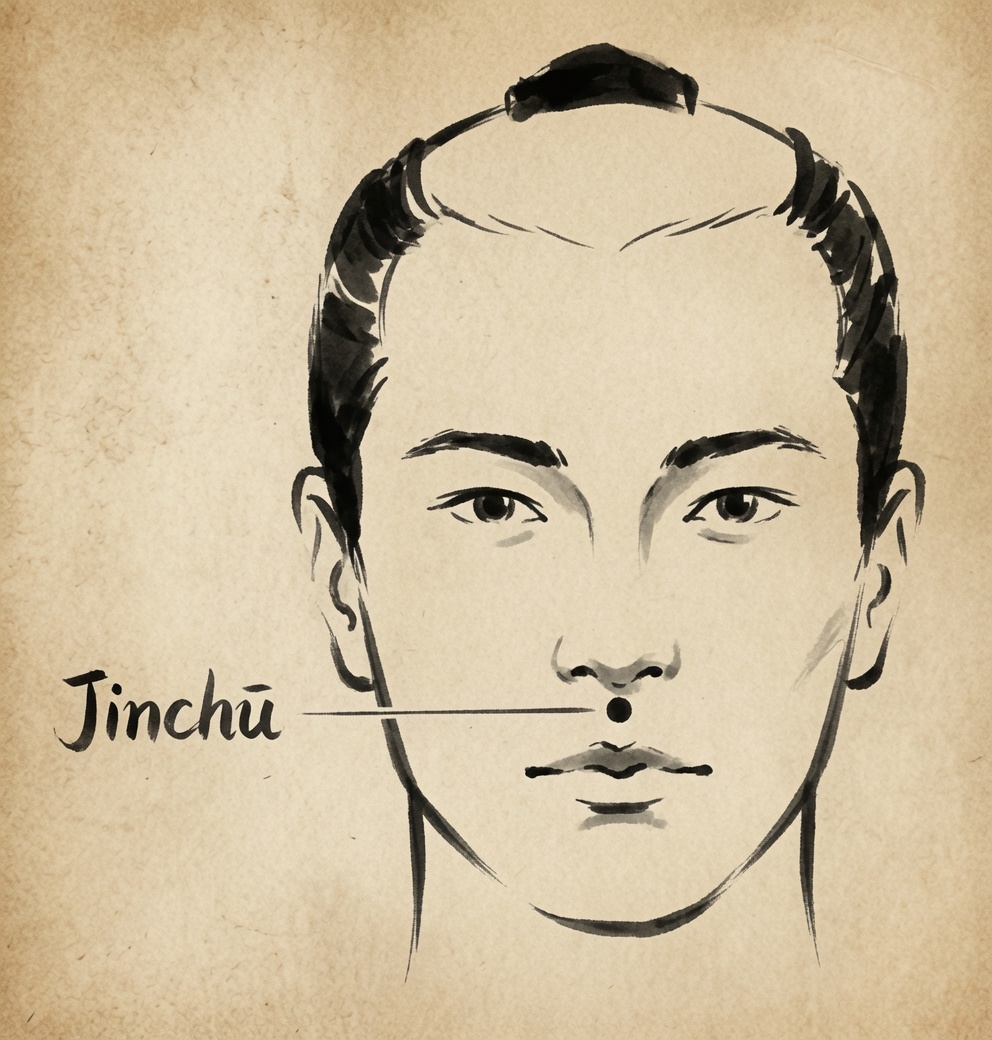
Jinchū Kyūsho refers to the philtrum. This vertical groove sits between the base of the nose and the upper lip. Chinese medical texts that reached Japan recorded the corresponding point as 水溝 Suikō (“Water Ditch”). Traditional Chinese Medicine calls it Rénzhōng (GV26). Japanese martial artists adopted the point and renamed it within their own vital-point systems.
Its location makes Jinchū accessible during close-range engagements. These engagements typify Jūjutsu. As a result, practitioners incorporated Jinchū into sequences that combine striking with throws and joint locks. Its position runs along the central facial line. Therefore, it became a practical target in many forms.
Historical Roots of Jinchū Kyūsho in Japanese Martial Traditions
Japanese martial schools received knowledge of Jinchū Kyūsho through Chinese medical theory. This transmission occurred during the early Edo period (1603–1868). Texts such as the 和漢三才図会 Wakan Sansai Zue supplied anatomical maps. Various acupuncture manuals also provided these maps. Koryū masters adapted the maps.
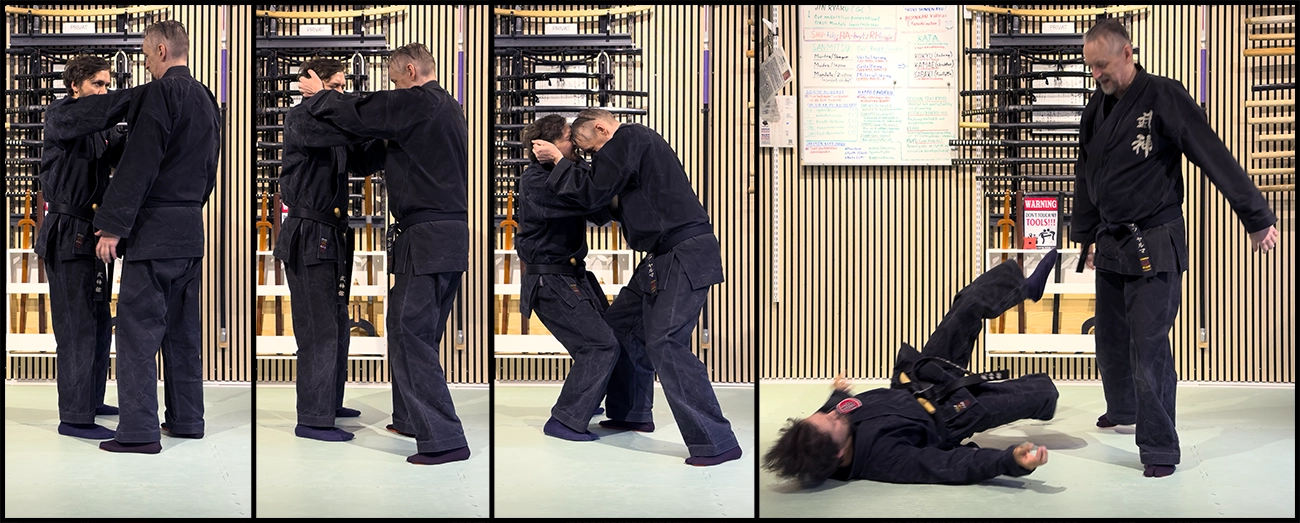
Masters reorganised these points into Japanese systems over generations. They did not treat Jinchū as an independent striking technique. Instead, they integrated it as an auxiliary method. This method disrupts posture or creates openings for Nage (Throwing) and Katame (Grappling). In addition, the approach aligns with the historical emphasis on 神武不殺 Shinbu Fussatsu (“The highest martial skill does not kill”). Many transmission scrolls contain this phrase. Consequently, Jinchū remained part of a controlled and ethical framework.
Jinchū Kyūsho Across Major Koryū Schools
Jinchū Kyūsho appears in the teachings of several established schools. In 楊心流 Yōshin-ryū lineages, including 天神真楊流 Tenjin Shinyō-ryū, it appears in lists of head points. Masters transmitted these lists through secret scrolls and oral instruction. 関口流 Sekiguchi-ryū records Jinchū under the local term すりかけ Surikake. The school includes related facial techniques among its 内術十二 Nai-jutsu Jūni (“Twelve Internal Techniques”) methods.
柴真楊流 Shiba Shinyō-ryū places Jinchū within its classification of thirteen head acute points. 神道六合流 Shintō Rokugō-ryū lists it among points that produce immediate effects. 柳生心眼流兵術 Yagyū Shingan-ryū Heijutsu incorporates similar facial targets within its continuous atemi sequences. These references show consistent recognition of Jinchū across diverse traditions. Moreover, they reveal variation in naming and emphasis. For example, some schools used local names while others retained the standard term.
Jinchū Kyūsho and the Art of Revival (Kappō)
Classical sources pair knowledge of striking points with revival methods. These methods are known as 活法 Kappō (“Resuscitation techniques”). Jinchū receives particular attention. Stimulation of the facial nerve in this area can reduce the immediate effectiveness of standard revival techniques.
Transmission documents therefore stress the need for layered revival protocols. This need arises when the point is involved. The requirement for precise revival knowledge alongside striking methods appears repeatedly in Yōshin-ryū and Tenjin Shinyō-ryū materials. These references reflect the integrated nature of Satsukatsu training. As a result, students had to master both striking and revival together.
Jinchū Kyūsho in the Context of Kyūsho Training
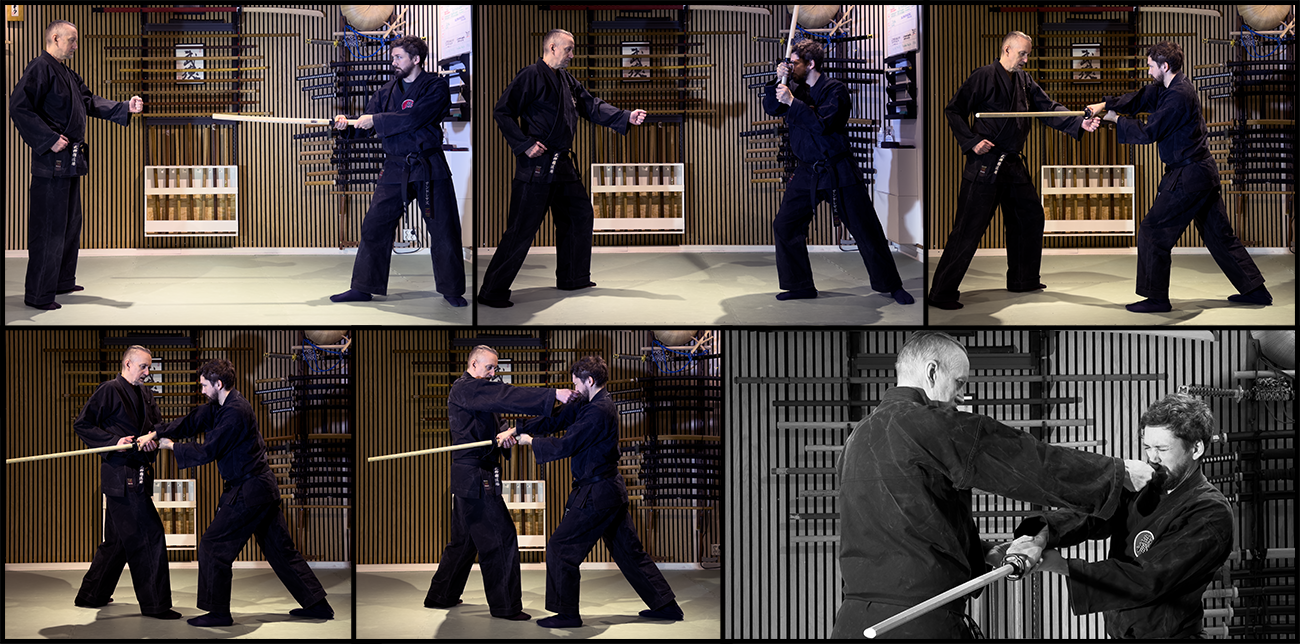
Jinchū Kyūsho represents one element within the broader study of 急所 Kyūsho (“Vital points”). Traditional training did not isolate individual points for separate practice. Students instead learned point locations, effects, and timing. They learned these elements as part of complete Kata sequences. These sequences combined Atemi with throwing and controlling techniques.
The book records that practitioners most often applied Jinchū as 先当て Saki-ate (“Preemptive strike”). They used it to break an opponent’s structure. They also applied it as 後当て Ato-ate (“Finishing strike”) after a throw. The goal was to prevent counterattack. Exact methods of application and the accompanying oral instructions varied between schools. Licensed practitioners alone received these instructions. In particular, the timing of the strike depended on the specific kata.
Integration of Jinchū Kyūsho in Koryū Technique
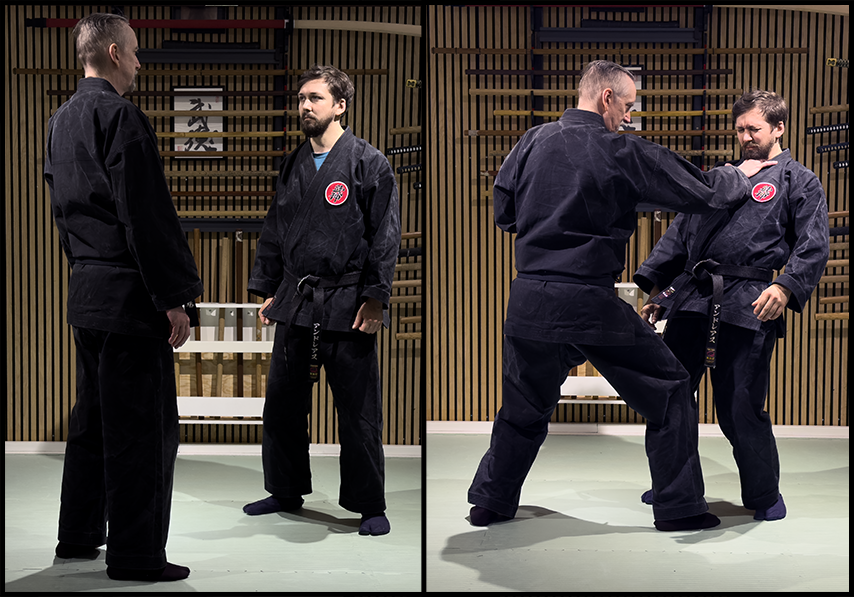
In practice, Jinchū supported the primary goals of Jūjutsu. It did not replace them. Strong stimulation here could affect facial nerves and coordination. This effect created a momentary opening for more decisive techniques. Historical records caution that the resulting effects made reliable revival more difficult. This difficulty explains why such points stayed within advanced levels of transmission.
The detailed classifications found in Shiba Shinyō-ryū illustrate how seriously masters treated these methods. The warnings preserved in later 史料編 Shiryō-hen documents also show this seriousness. Study of Kyūsho, including Jinchū, formed part of a larger technical and ethical framework. It did not function as an independent striking curriculum. Furthermore, this integrated approach helped preserve the original intent of the art.
Conclusion
Jinchū Kyūsho appears consistently across multiple Koryū schools. This pattern shows how Japanese martial artists systematically adapted external medical knowledge. They turned it into functional combative systems. Its role remained auxiliary. It supported throws and joint locks while demanding careful attention to revival methods.
Modern examination of these traditions reveals both the sophistication and the limitations of the original teachings. Researchers continue to find interest in Jinchū. It exemplifies the integrated approach to atemi and kappō. This approach defined much of classical Jūjutsu. Serious study of Kyūsho as a complete subject offers the clearest path to understanding this aspect of Japanese martial heritage. Researchers gain clearer insight when they avoid isolating individual points. In addition, this broader perspective helps preserve the original technical and ethical balance of the traditions.
Historical Source: From Tenjin Shinyō-ryū to Jūdō, and then to Karate
The Atemi shikatsu methods transmitted by Tenjin Shinyō-ryū Jūjutsu, which enjoyed great prosperity in the late Edo period, have almost completely died out except for seikotsu techniques. Kōdōkan Jūdō, which eliminated Atemi from its technical system, continued practical instruction while theory alone continued independently. Meanwhile, Karate, transmitted from Okinawa to the mainland during the Taishō era, also carried over only solo forms from China to Okinawa and then to the mainland; the essential Atemi theory was supplemented from Kōdōkan Jūdō when kumite was created.
However, from the mid-Shōwa period onward, as competitive Karate spread mainly in universities, attack targets were standardized into jōdan, chūdan, and gedan, expanding from points to areas, rendering knowledge of vital points unnecessary. Vital point knowledge, which is important for self-defense, also became superfluous due to sportification (use of protective gear and controlled contact).
Here, explanations of vital points in Meiji-era Jūdō and in Karate up to the early Shōwa period, which still retained elements of self-defense, are introduced as material for considering the differences between the two.
While Jūdō’s Atemi explanations follow those of classical Jūjutsu, in Karate it is stated that “the opponent is brought to death,” and the free control of killing and reviving has been lost. Of course, there is no explanation of kappō.
In other words, rather than a self-defense art that does not injure the opponent, it has become a killing art that kills the opponent — the result of a complete failure to understand the principles of martial arts.
講道館柔道の急所解説
Kōdōkan Jūdō Vital Point Explanations
(from ‘Kassatsu Jizai Jūdō Gokui Kyōhan’ by Iguchi Yoshitame, Shōwa 8)
〇天道 Tentō (Heavenly Path)
The area of the frontal bone. Tentō is the top of the head. Tendō is the place on the head where the pulse is struck, commonly called “odori-ko” in children. Striking Tendō strongly causes the three major bones of the head to open and leads to death. There is no revival method. If one faints from striking Tendō, revive with breathing techniques or the inducing revival (Yū no Kappō). It is a vital point that reaches the heart.
〇烏兔 Uto (Crow and Rabbit)
The center of the face, between both eyes above the nose. When struck, it causes dizziness and fainting. Striking even one sun away from this point is a vital point that can cause nosebleeds.
〇人中 Jinchū (Human Center / Philtrum)
The exact center between the nose and upper lip. Extremely important. When struck strongly, it is difficult to revive even with breathing techniques or revival methods. It affects the facial artery, nerves, bones of the upper jaw, trigeminal nerve, respiratory obstruction, etc. It is a major killing point. Must be handled with extreme caution.
〇カツコン Katsukon
The place between the chin and lower lip. This strike is the same as Jinchū. Even if revival methods are applied, they are ineffective. The causes are the same as above.
〇霞 Kasumi (Mist)
The temple bones, commonly called “komekami.” Striking here causes severe brain reaction and disturbance of various nerves, leading to fainting.
〇両毛 Ryōmō (Both Hairs)
Used frequently in forms together with Kasumi. It is at both corners of the eyes, one sun below Kasumi. Striking here causes fainting in the same way as above.
〇独古 Dokko (Solitary Ancient)
The place behind both ears. It is frequently used in forms. It is the area behind the ear. Striking here strongly affects the origin of the ear muscles and the area behind the ear, pressing blood vessels and nerves.
〇秘中 Hichū (Secret Center)
This Hichū is the first major killing point used in forms, randori, and pinning techniques. The center of the throat, above the sternum. It drives the windpipe, damages the respiratory organs, and affects the lungs, leading to fainting.
〇松風村雨 Matsukaze Murusame (Pine Wind and Village Rain)
Matsukaze (some schools call it Fūgetsu) and Murusame are the left and right sides of the shoulder blade and tongue muscle area (see diagram). The right is Matsukaze, the left is Murusame. These are major killing points.
〇膻中 Danchū (Danzhong)
Commonly called “mizuochi.” This strike is at the center of the sternum in the chest. When struck, it causes nerve shock, sudden change in blood circulation, and cessation of breathing, leading to fainting. However, it can be revived with inducing revival, heart revival, back revival, or collar revival.
〇雁下 Kari-shita (Below the Goose)
Kari-shita is striking one sun below both nipples in all four directions. The causes of fainting and revival methods are the same as above.
〇稲妻 Inazuma (Lightning)
Inazuma refers to the left and right sides of the floating ribs. Commonly called the third rib. The causes of fainting and revival methods are the same as for the abdomen.
〇水月 Suigetsu (Water Moon)
Suigetsu is striking directly below the heart at the lower end of the stomach organ. It stimulates the divine pulse and causes fainting due to three causes: brain reaction, nerve shock, and pulse obstruction. Revival is done with artificial respiration. If that does not work, use back revival or inducing revival.
〇明星 Myōjō (Bright Star)
Myōjō is kicking or striking one sun and four directions below the navel. It violently affects the large intestine, small intestine, and bladder, causing cessation of breathing. Revival is done with collar revival, scrotum revival, back revival, or artificial respiration.
〇陰囊 In-nō (Scrotum)
Striking the scrotum (commonly called testicles) by kicking or thrusting damages the bladder, rectum, testicles, sympathetic nerves, spermatic artery, etc., causing cessation of breathing. Apply scrotum revival. The testicles may enter the abdomen. Must be handled with great care.
〇向骨 Kōkotsu (Facing Bone)
Striking Kōkotsu only causes pain throughout the body and does not cause death. If fainting occurs, revive with inducing revival.
〇草靡 Kusanabi (Grass Bending)
Kusanabi is striking the place commonly called “tsuchi-fumazu” and the calf as shown in the diagram. The whole body feels pain and one falls.
〇内外踝 Nai-ge-kyō (Inner and Outer Ankle)
The ankle is the same as Kōkotsu. Pain reaches the brain but does not cause death. If fainting occurs, apply inducing revival.
〇早打 Hayachi (Early Strike)
Hayachi is the place where acupuncturists needle when the shoulders are severely stiff. Striking here sometimes leads to death. In such cases, rub the chest and apply inducing revival or collar revival. Striking here damages the brain, lungs, and ribs, causing cessation of breathing. Must not be needled carelessly. Very important.
〇活 Katsu (Revival)
This revival point is slightly to the left in men and to the right in women between the first and sixth or seventh vertebrae of the spine. This revival method is the most frequently used among the thirteen total revival methods.
〇電光 Denkō (Lightning)
Denkō: (1) Striking the third thoracic vertebra affects the lungs. (2) Striking the fifth thoracic vertebra affects the heart. (3) Striking the sixth thoracic vertebra causes fainting due to violent shock to the spinal cord center.
〇後稲妻 Go-inazuma (Rear Lightning)
Go-inazuma is the place shown in the diagram. Striking here causes pain throughout the body and one falls. Apply yin-yang revival to this place. Details are explained in the revival section.
〇下閨 Gekei (Lower Gate)
Gekei is the anus. Explanation regarding this is most essential for jujutsu practitioners and is explained in detail in the revival section of the volume.
〇尺澤 Shaku-taku
Shaku-taku is frequently used in forms. It is between the brachioradialis and extensor digitorum muscles. Striking here stimulates the nerves and causes fainting due to unbearable pain. It affects the radial nerve, ulnar nerve, and fascia.
空手の急所解説
Karate Vital Point Explanations
(from ‘Karate Nyūmon’ by Ishiguro Keishichi, Shōwa 43)
〇天道 Tentō (Heavenly Path)
The top of the head. Striking here with a forefist, fist, hand blade, etc., can kill the opponent.
〇天倒 Tentō (Heavenly Fall)
Commonly also called “odoriko.” Slightly forward from the top of the head. Striking here with a forefist, backfist, hand blade, etc., can kill the opponent.
〇霞 Kasumi (Mist)
The temples on both sides. Striking here with a one-finger fist, backfist, hand blade, etc., can kill the opponent.
〇耳 Mimi (Ear)
Same effect as Kasumi when attacked in the same way.
〇鳥兔 Uto (Crow and Rabbit)
The glabella, the center between the eyes. Striking here with a forefist, backfist, etc., can kill the opponent.
〇晴雲 Seiu (Clear Cloud)
Above and below both eyes. Attack here with spear hand, one-finger fist, or half-fist.
〇眼星 Gansei (Eye Star)
The center of the eyeball. Attack here with spear hand, one-finger fist, or backfist.
〇人中 Jinchū (Human Center / Philtrum)
The groove between the nose and mouth. Attack here with forefist, backfist, one-finger fist, hand blade, etc.
〇下昆 Gekon (Lower Kon)
The place between the mouth and lower jaw. Striking here with forefist, one-finger fist, hand blade, etc., can kill the opponent.
〇三日月 Mikazuki (Crescent Moon)
The chin. Attack here with forefist, foot hammer, elbow strike, etc.
〇独古 Dokko (Solitary Ancient)
Slightly behind the ear in the depression. Attack here with one-finger fist, fist, or hand blade.
〇頸中 Keichū (Neck Center)
The hollow at the back of the neck (bon-no-kubo). Striking here with forefist, fist, or one-finger fist can kill the opponent.
〇松風 Matsukaze (Pine Wind)
Also called Fūgetsu. The side of the head. Attack with clenched fist, fist, hand blade, elbow strike, etc., and it can kill the opponent.
〇村雨 Murusame (Village Rain)
The front side of the neck. Attacking in the same way as Matsukaze can kill the opponent.
〇秘中 Hichū (Secret Center)
Commonly called the Adam’s apple. Attack with clenched fist, elbow strike, knee blade, foot kick, etc.
〇膻中 Danchū (Danzhong)
The upper end of the breastbone. Attack in the same way as Hichū.
〇胸尖 Kyōsen (Chest Tip)
The lower end of the breastbone. Attack in the same way as Hichū.
〇水月 Suigetsu (Water Moon)
The solar plexus. Striking here with forefist, spear hand, elbow strike, knee blade, foot kick, etc., can kill the opponent.
〇脇影 Waki-kage (Armpit Shadow)
Between the fifth and sixth ribs in the armpit. Striking here with clenched fist, elbow strike, foot kick, etc., can kill the opponent.
〇雁中 Kanchū (Goose Center)
Below both nipples. Attack in the same way as Waki-kage.
〇電光 Denkō (Lightning)
Also called the flank. Between the seventh ribs on the front side of the upper abdomen. Striking here with forefist, fist, hand blade, or foot kick can kill the opponent.
〇稲妻 Inazuma (Lightning)
The front side of the upper abdomen at the lower end of the eleventh and twelfth floating ribs. Attack in the same way as Denkō to kill the opponent.
〇明星 Myōjō (Bright Star)
Commonly called the lower Tanden, one sun below the navel. Striking here with forefist or foot can kill the opponent.
〇早打 Hayachi (Early Strike)
On the back between the third and fourth ribs, inside the shoulder blade. Attack here with forefist or elbow strike.
〇活殺 Katsusatsu (Killing and Reviving)
Between the fifth and sixth vertebrae of the spine. Attack here in the same way as Hayachi to kill the opponent.
〇後電光 Go-denkō (Rear Lightning)
The lowest end of the spine, the coccyx. Striking here with forefist or foot kick can kill the opponent.
〇腕馴 Udenare (Arm Training)
The middle of the upper back side. Attack here with fist or hand blade.
〇时詰 Hijizume (Elbow Joint)
Also called the elbow joint. The outer side of the elbow. Attack in the same way as Udenare.
〇腕関節 Ude-kansetsu (Elbow Joint)
Twist or break the elbow joint, or attack with fist or hand blade.
〇小手 Kote (Forearm)
The forearm. Scissor or snap it, or attack with fist, hand blade, or elbow strike.
〇内小捕 Uchi-kote (Inner Forearm Capture)
Also called the pulse point. Attack here with forefist, one-finger fist, or fist.
〇外小捕 Soto-kote (Outer Forearm Capture)
The opposite side of the pulse point. Attack in the same way as Uchi-kote.
〇手甲 Tekō (Back of the Hand)
The back of the hand. Attack in the same way as Uchi-kote.
〇金的 Kinteki (Golden Target)
Also called Tsurigane. The testicles. Striking here with forefist, knee blade, foot kick, or clenched fist can kill the opponent.
〇夜光 Yakō (Night Light)
The front inner side of the upper thigh. Attack with forefist or foot kick.
〇伏兎 Fukuto (Crouching Rabbit)
The front outer side of the lower thigh. Attack in the same way as Yakō.
〇膝関節 Shitsu-kansetsu (Knee Joint)
Attack the knee joint with foot kick or stomp break.
〇向骨 Kōkotsu (Facing Bone)
The front center of the shin bone. Attack with forefist or foot kick.
〇內踝 Nai-ka (Inner Ankle)
Just below the inner ankle bone on the inner side of the tarsal bones. Attack here with hammer fist or hand blade.
〇甲利 Kōri (Top of the Foot)
The top of the foot. Attack with stomping crush, etc.
〇草隠 Kusagakure (Grass Hidden)
Slightly to the outer side from the top of the foot. Attack in the same way as Kōri.
〇尾胝 Bitai (Coccyx)
The lowest end of the sacrum. Attack here with knee blade.
〇後稲妻 Go-inazuma (Rear Lightning)
The upper center of the back side of the thigh. Attack with forefist or kick.
〇草靡 Kusanabi (Grass Bending)
The center of the back side of the lower leg. Attack with foot kick, etc.
小佐野淳 Osano Jun
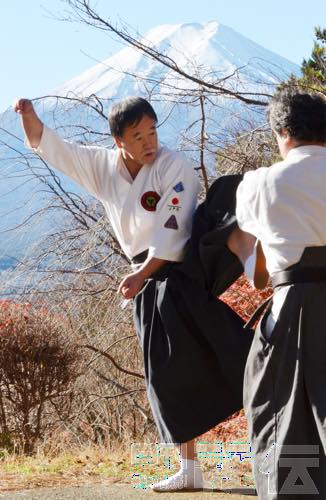
Born in Fujiyoshida City, Yamanashi Prefecture. While a student, studied Chinese martial arts and classical Jūjutsu at the Chigasaki branch of the All-Japan Chinese Kenpō Federation. In 1982, founded the Kobudō Shidōsho Suigetsu Juku. While teaching at Suigetsu Juku, trained in bujutsu transmitted in various former domains. Served as certified instructor, council member, auditor, and public relations director of the International Budo-in. Received the Budō Kōrō-shō (Martial Arts Meritorious Service Award) from the International Budo-in in 1992. Founded the International Suigetsu Juku Bujutsu Association in 2002 and assumed the positions of president and supreme instructor. Honorary advisor to the Jinmō Kenpō Association, Changhua County, Taiwan. Vice president of the Matsudaira-han Bunbu Gakkō Budōkai. Author of numerous books and papers.
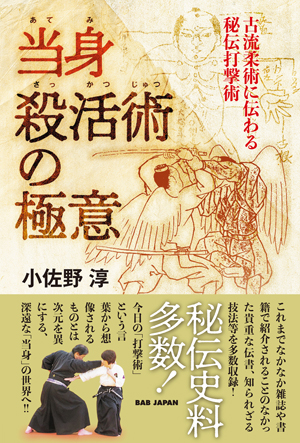
当身殺活術の極意 〜古流柔術に伝わる秘伝打撃術〜 by 小佐野淳
Publisher : BABジャパン
Publication date : August 22, 2025
Language : Japanese
Print length : 300 pages
ISBN-10 : 4814207301
ISBN-13 : 978-4814207305
Item Weight : 280 g
Dimensions : 7.4 x 5 x 0.79 inches