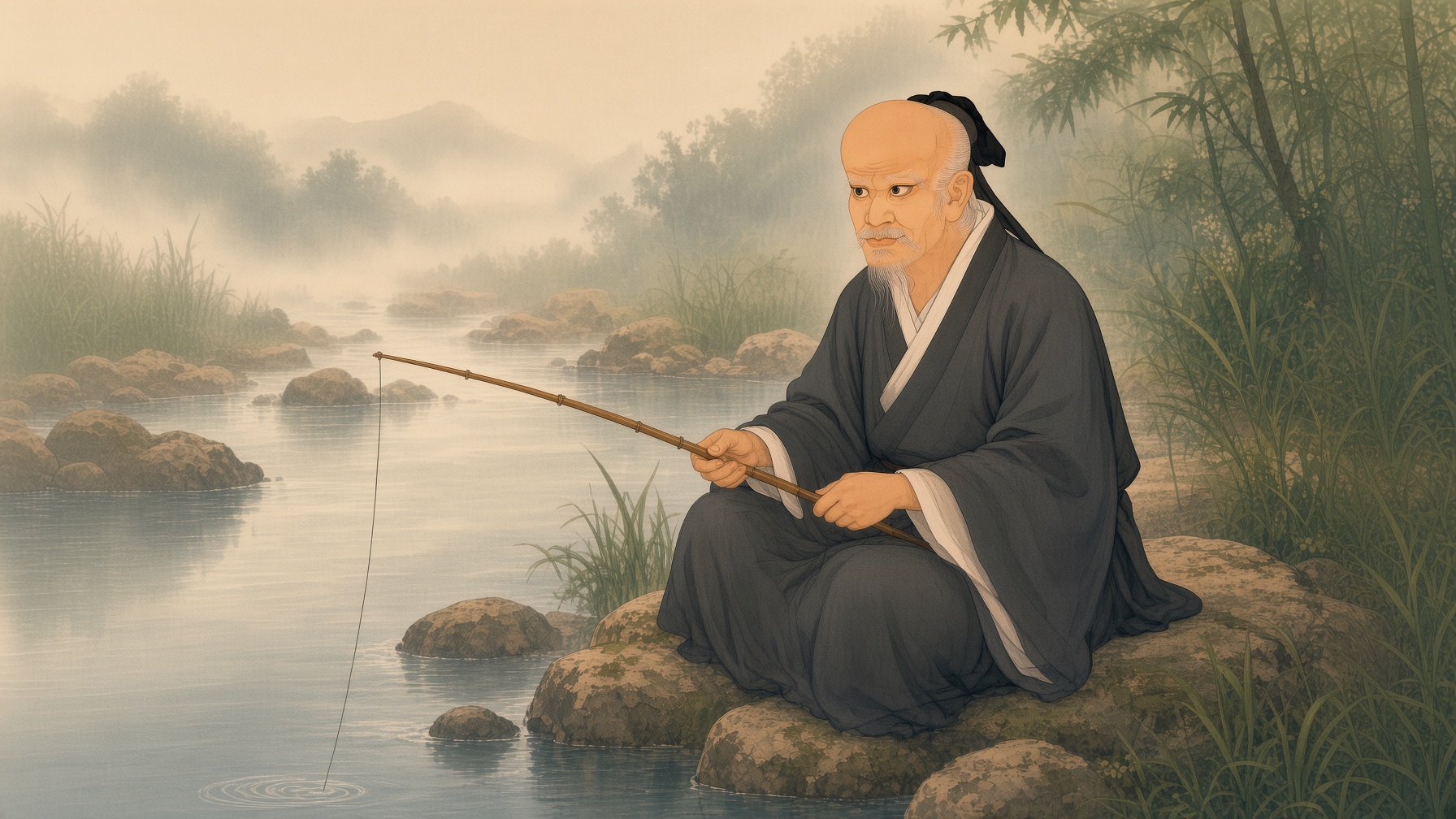
It is said that the Amatsu Tatara scrolls were found inside the belly of a fish 3000 years ago. I came across a similar story about Taikōbō (Taigong Wang). In that legend the sage fished for years with a bare thread until a carp rose from the river carrying a book of profound military strategy in its belly. Both accounts describe sacred strategic knowledge arriving sealed inside a fish and later entrusted to those who would guide the fate of nations. The shared imagery is striking enough to raise the question: could this ancient Chinese tale be one possible root source for the Amatsu Tatara transmission?
Amatsu Tatara and Kukishin History
The Amatsu Tatara Hibumi (secret scrolls) are legendary documents containing profound teachings on martial arts, spiritualism, and humanism.
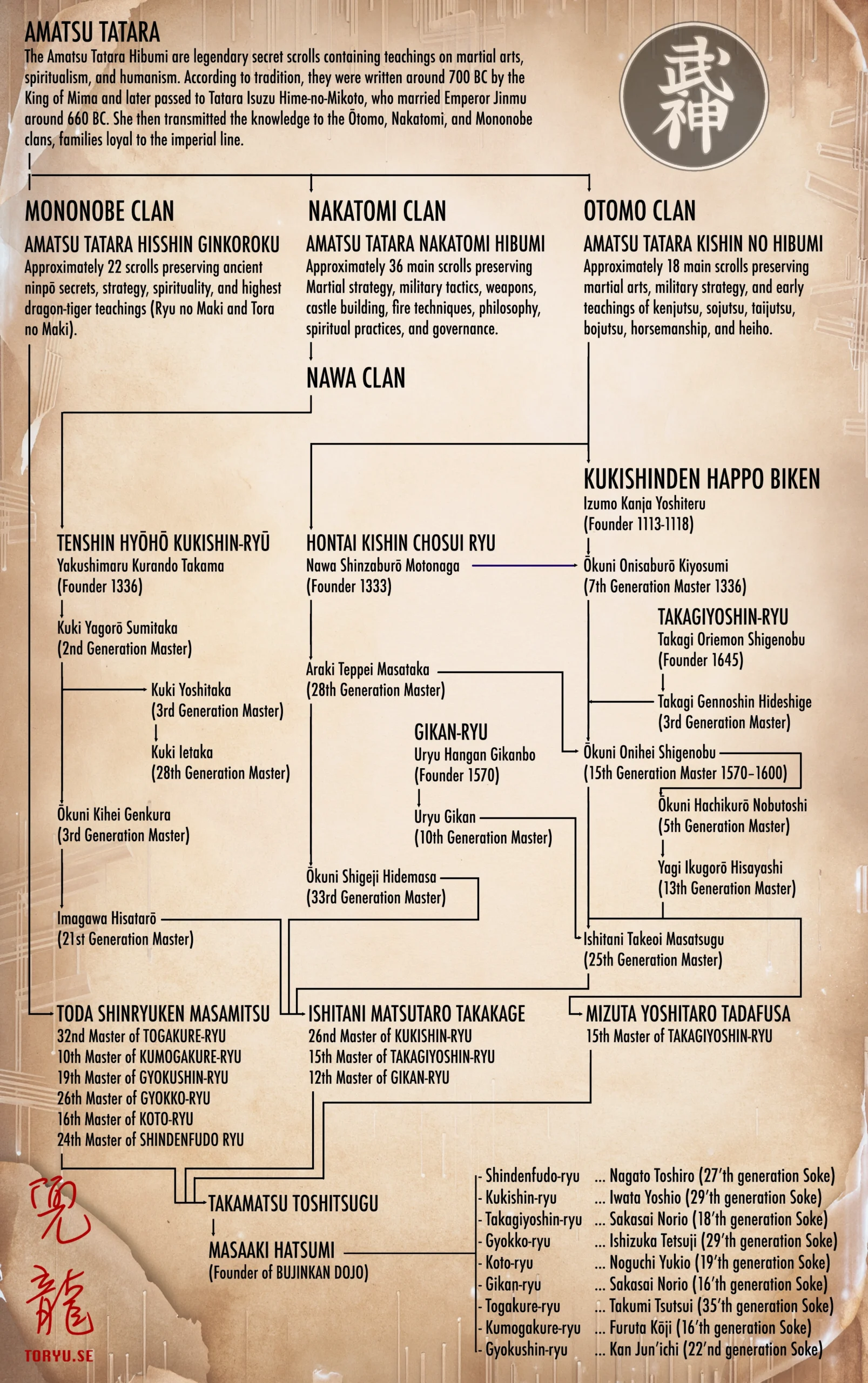
According to tradition, the scrolls were written around 700 BC by the King of Mima. They were later passed to Tatara Isuzu Hime-no-Mikoto, who married Emperor Jinmu, the first Emperor of Japan, around 660 BC. She then transmitted the sacred knowledge to the Ōtomo, Nakatomi, and Mononobe clans — families known for their unwavering loyalty to the imperial line.
The origin of Kukishin Ryū can be traced back to the activity of the Taiheiki Era (approximately 1333). At that time (also known as the Nanboku-chō Era), Nawa Shinzaburō Motonaga and his elder brother, Nawa Kotarō Nagataka (later known as Nawa Nagatoshi, the leader of the Izumo-bushi), and their clan protected Emperor Go-Daigo in the Izumo and Hōki areas (present-day Tottori and Shimane Prefectures), where they raised an army. With Nagatoshi as their leader, and Nawa Shichirō Kunitaka (who was a master of military strategy and martial arts), they formed a powerful clan. Together with monks from Shikoku and Kyushu, they numbered more than 4,000 men.
After the Taiheiki Era, Nawa Shinzaburō Motonaga took the Amatsu Tatara Hitei no Maki scroll that his family possessed and brought it to Mt. Kōya. There, he visited his ancestors’ graves to pray while staying at his family’s temple, Hōshō Temple’s Hosono-an. He became a monk and studied for enlightenment. Nawa Shinzaburō Motonaga taught Ōkuni Onisanta Kiyosumi, son of Ōkuni Onigenta Kiyosada. Kiyosumi then spread the teachings, known by the name Kishin no Jutsu. Kiyosumi taught his son, Onihachirō Kiyochika, as well as Narita Kojirō Kingo.
Later, Kingo went to Kumano and became a gyōja (ascetic). Yakushimaru Takasada, one of his students, was a master of military strategy and very good at bōjutsu. He later helped protect Emperor Go-Daigo. He received the family name “Kuki” from the Emperor, and after this gave the name Hontai Chōsui Kukishin Ryū to his martial art. This new Kuki family continued to teach their style of martial arts to their descendants.
Around the time of the Edo Era, when they were awarded management of the land, the area where they lived came to be called Ayabe-han and Sanda-han. Ōkuni Onigenta Kiyosada, who was taught the Amatsu Tatara Hitei no Maki by Nawa Shinzaburō Motonaga, taught his son Onisanta Kiyosumi. He, in turn, taught his son Onihachirō Kiyochika. Ōkuni Onisanta Kiyosumi, on the 16th of August 1359 (the 140th year of the Shōhei Era), as a member of the Nawa clan, together with the Chigusa and the Kikuchi Takemitsu clans led by the Seiseitai Shogun Kanenaga Shinnō (a son of the Emperor), fought against Shōni Yorinao. Kiyosumi charged into the enemy army on horseback, breaking their ranks. He then set fire to the enemy camp’s command position. Kiyosumi received a promotion as a result.
Some members’ names from later generations who were taught are:
- Ōkuni Kawachi no Kami Masayoshi,
- Ōkuni Onihei Hisayoshi,
- Ōkuni Izumonokami Takamochi,
- Ōkuni Kogenta Yukihisa, and
- Ōkuni Onihei Yoshitane.
Ōkuni Onihei Shigenobu continued to teach his family’s Amatsu Tatara hiden (secret teachings) and became a martial arts master. He became an ascetic in Kumano where he learned Yakushimaru-den from the monk Kuki Shunseibō. Later, he restored Kukishin Ryū Bōjutsu, Naginatajutsu, Yarijutsu, and Taijutsu. While living in Izumo, Ōkuni Onihei Shigenobu was a recognized master of martial arts, and sometimes visited the dōjō of Takagi Gennoshin at his request. He stayed for a while as Gennoshin’s guest and taught bōjutsu to the students. Gennoshin became ill, and while on his sickbed he requested Onihei to take care of things after his death. Gennoshin soon passed away.
Another story has it that Gennoshin and Onihei had both a bōjutsu match and a jūjutsu match. Onihei defeated Gennoshin with his bōjutsu, but Gennoshin beat Onihei with his jūjutsu. That is why the jūjutsu continues as the Takagi Yōshin Ryū, and bōjutsu, yarijutsu, and naginatajutsu are continued as the Kukishin Ryū. Onihei, as the 4th generation sōke, gave these arts the names Hontai Takagi Yōshin Ryū Jūjutsu and Kukishin Ryū Bōjutsu, Yarijutsu, Naginatajutsu, and they have continued to be handed down in this way together. These arts were passed down from generation to generation until the Tempō Era (1830–1840), when they were divided up between three high-ranking students: Fujita Togorō, Inoue Kumatarō, and Ishitani Takeo. After Yagi Ikugorō relocated to the Akashi area, Fujita Tōgoro and Mizuta Yoshitarō carried on our lineage.
Takamatsu Letter to Ueno Takashi
The following letter was originally written by Sōke Takamatsu Toshitsugu Uō to the 39th Generation Ueno Takashi Tenshin on an auspicious day in December 1954. The letter now belongs to the 42nd Generation Sōke Kobayashi Chōsui. The letter reads:
Regarding the Amatsu Tatara Shinden, it is a sacred treasure that has been handed down as an oral tradition for posterity from the miraculous works of Ōkuninushi. His works were written on necklaces, pieces of wood, animal skins, and other materials, then passed down by religious masters and ancient emperors.
For example, of the two Heaven and Earth Treasures, the Heaven Scroll (Ten no Maki) holds the secrets of a religious/spiritual nature, and the Earth Scroll (Chi no Maki) holds the secrets of a martial nature. Similarly, “Amatsu” is religious, and “Tatara” is martial. The Heaven and Earth scroll secrets (Tenchi no Maki no Okugi) are divided into four sections, known as the “Shii no Ihō” (Four Sacred Treasures). Of these four, the Amatsu Tatara’s Nakatomi Hibun and Mononobe Hibun are religious in nature, while the Amatsu Tatara’s Ōtomo Hibun and the Ōhikonaga Hibun are martial in nature.
These Four Sacred Treasures, from the time of Toyotomi to the Tokugawa Era, were divided, arranged, and separated into 106 sections. Collectively they are known as the Shinmei-shii no Hiden, and are said to be the foundation of all religious sects and martial arts of Japan. It is known that these 106 scrolls, in October of the year 1640 (the 17th year of the Kan’ei Era), were kept in the Kōyo Yamashita storeroom for precious artifacts in Edo Castle. Today, the Shii no Ihō are known by the names Takamagahara Hisen no Maki, the Hitei no Maki, the Senkaku no Maki, and the Hyōtei no Maki. (The 106 scrolls were later re-organized and put into four sections again.)
Kishin Chōsui Ryū was founded using the Amatsu Tatara Gorin Hitei no Maki as its foundation. This ryū was later inherited by the Izumo family, a warrior clan (Buzoku), and passed down from master to master through the generations. Some members of the Minamoto Kotarō Nagataka family who lived in Nawa-shō and mastered the ryū were:
- Nawa Shichirō Kunitaka
- Ōkuni Kanbe Kiyoshige
- Ōkuni Onitōta Otsumaro
- Nawa Shinzaburō Motonaga
On March 7th, 1332 (the 2nd year of the Genkō Era), after his overthrow by Hōjō Takatoki, Emperor Go-Daigo was guarded on his way to the prison island of Oki by several thousand Izumo bushi, along with warriors from Shikoku and Kyushu.
Later, the Amatsu Tatara Hitei no Maki was taken to Mt. Kōya by the enlightened Nawa Shinzaburō Motonaga, who went to pray at his ancestors’ graves. On Mt. Kōya, he passed the teachings to Ōkuni Onisanta Kiyosumi, son of Ōkuni Onigenta Kiyosada. Kiyosumi then spread the teachings of the Kishin Chōsui Ryū. Ōkuni Onisanta Kiyosumi’s son, Onihachirō Kiyochika, and Narita Kosaburō’s son, Narita Kojirō Kingo, were also taught. Kojirō Kingo became an ascetic in Kishū Kumano. Furthermore, Yakushimaru Takasada, a master of bōjutsu, was taught other martial skills. Yakushimaru finally named this collection of skills Hontai Kishin Kukishin Ryū. Around this time, both the Kishin Chōsui Ryū and the Kishin Kukishin Ryū were established.
The word “Kishin” is based on the Ōtomo family’s densho of the Amatsu Tatara Hibun, not the densho that the contemporary Kuki family possesses. The Kuki family ancestors come from the Nakatomi family, so they hold the Nakatomi Hibun of the Amatsu Tatara. It so happened that Yakushimaru Takasada, known for his bōjutsu skills and as the founder of Kukishin Ryū, was thought to be a member of the Kuki family because the name of the ryū contained the word “Kuki” — but this is not correct. This ryū was named Kukishin Ryū because of the Kishin Shihō-den. The Shihō-den contains nine types of martial skills, allowing the practitioner to fight with a “demon spirit,” hence the name Kukishin Ryū (Nine Demon Spirit School). A superbly advanced martial artist can understand this. It is said that the Kishin sacred scrolls were acquired from the belly of a fish. Nawa Shinzaburō Motonaga took these sacred scrolls to Mt. Kōya. There, he entered Hōshō Temple’s Hosono-an, where he mastered both martial arts and literature. He later taught Ōkuni Onitōta Otsumaro and a priest from Kumano named Yakushimaru Kurando. At that time, Yakushimaru named his martial art Kukishin Ryū, and Ōkuni Onitōta Otsumaro called it Kishin-Den Chōsui no Jutsu.
Urabe Sukune Kanesada was taught by a Chinese kenpō master named Jin Sonshi Rigi of Innō Kyokurin. He mixed this knowledge with his own taijutsu skills, named it dakenjutsu, and spread it widely. Izumo Kanja Yoshide also named the art Kishin Dakentaijutsu and spread it widely. Among all the schools of jūjutsu and taijutsu, this Kishin Chōsui Ryū (also called Kukishin Ryū) contains techniques for certain victory. Dakenjutsu is on the same level as karate, but with certain additional knowledge a person can knock down their opponent with Dakentaijutsu. Even when facing an incredibly strong and fierce opponent, with Kishin Chōsui Ryū Dakenjutsu you can throw them as easily as 1-2-3. There are very few people who have mastered this ryū because only one person can inherit the true spirit and skills. This is the dakenjutsu kaiden method, as described in the initiation instructions contained in the Amatsu Tatara Tora no Maki. There is only one successor, and in the future it will be the same as today. This requires very hard ascetic training, as described in the scroll, in order to become the next successor.
Takamatsu Letter to Hatsumi Masaaki
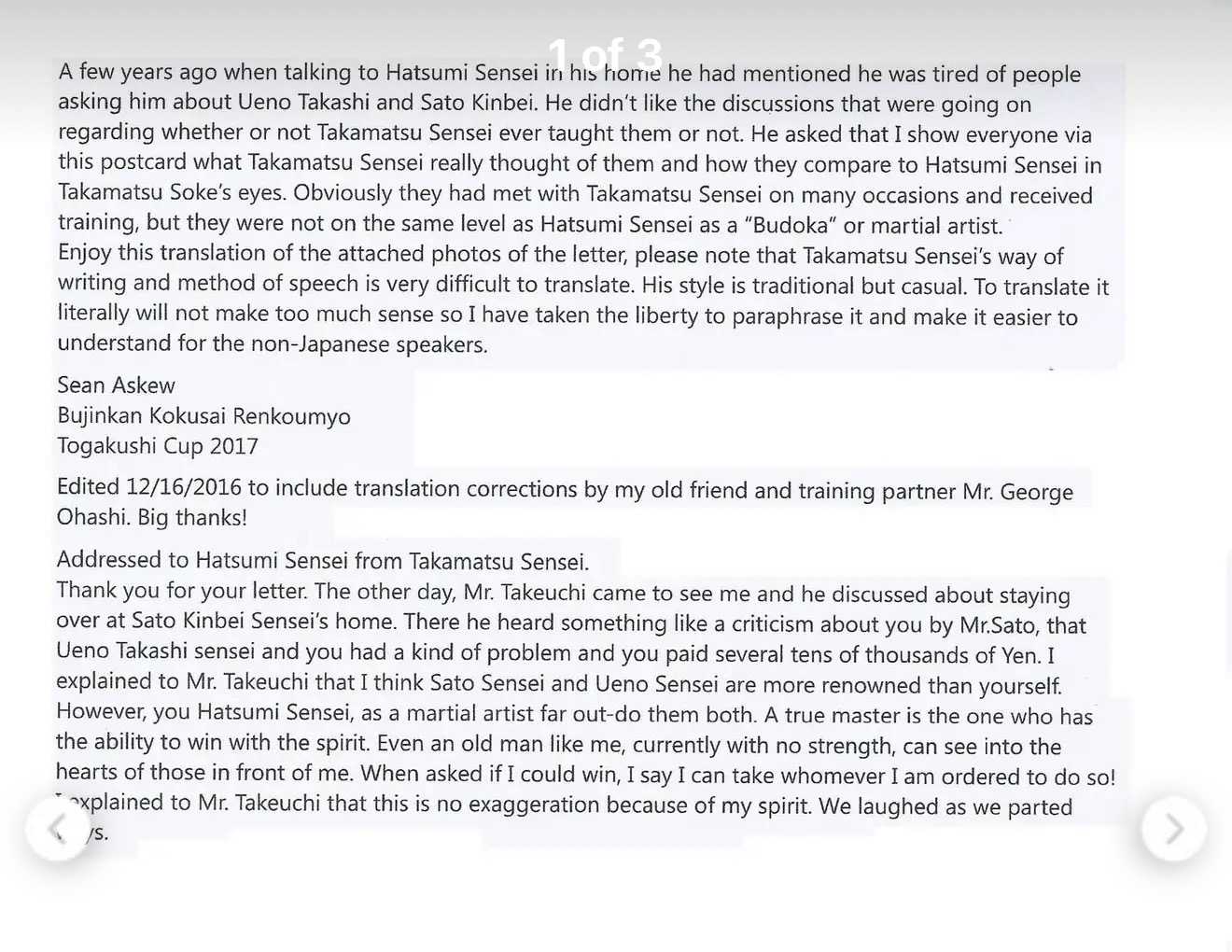
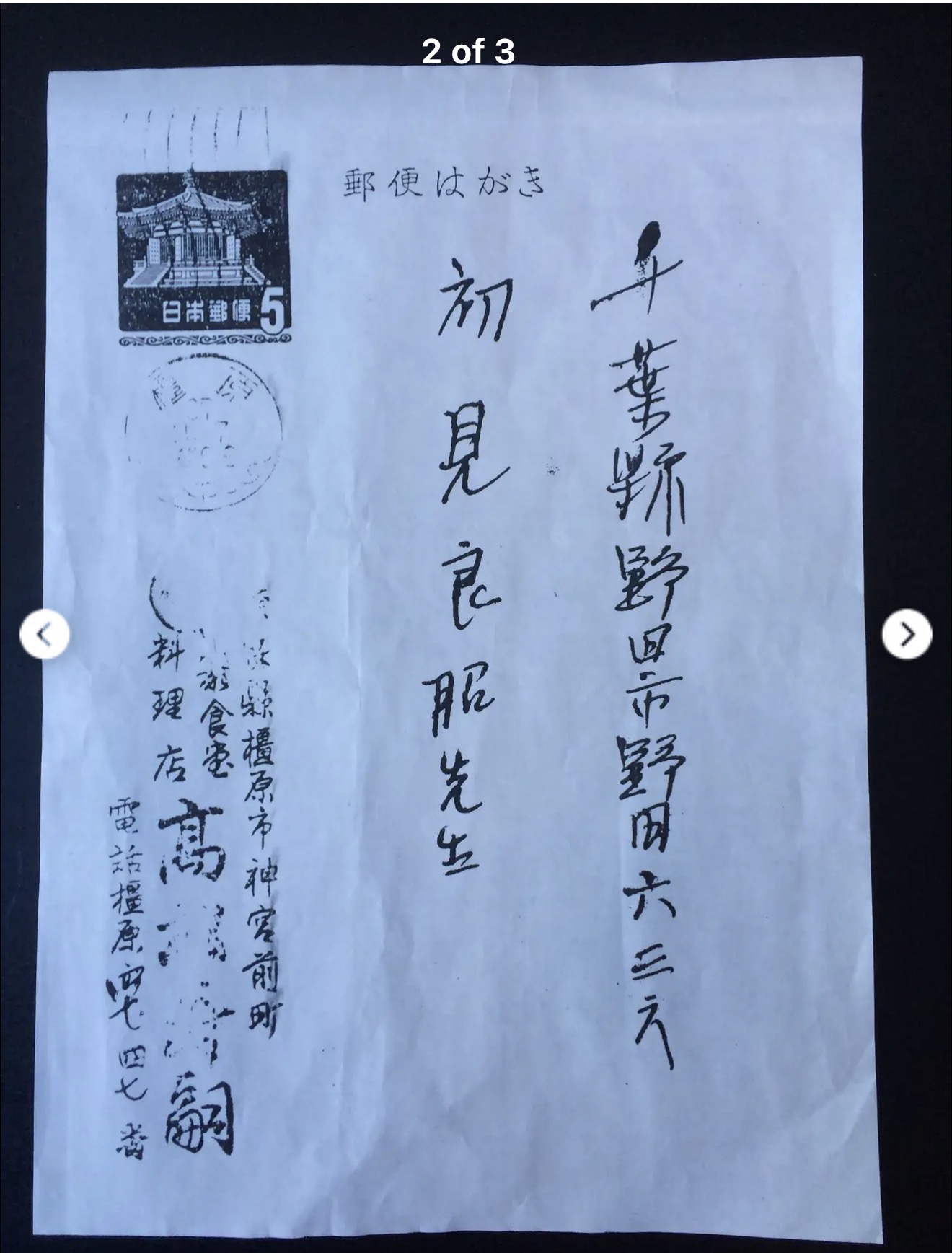
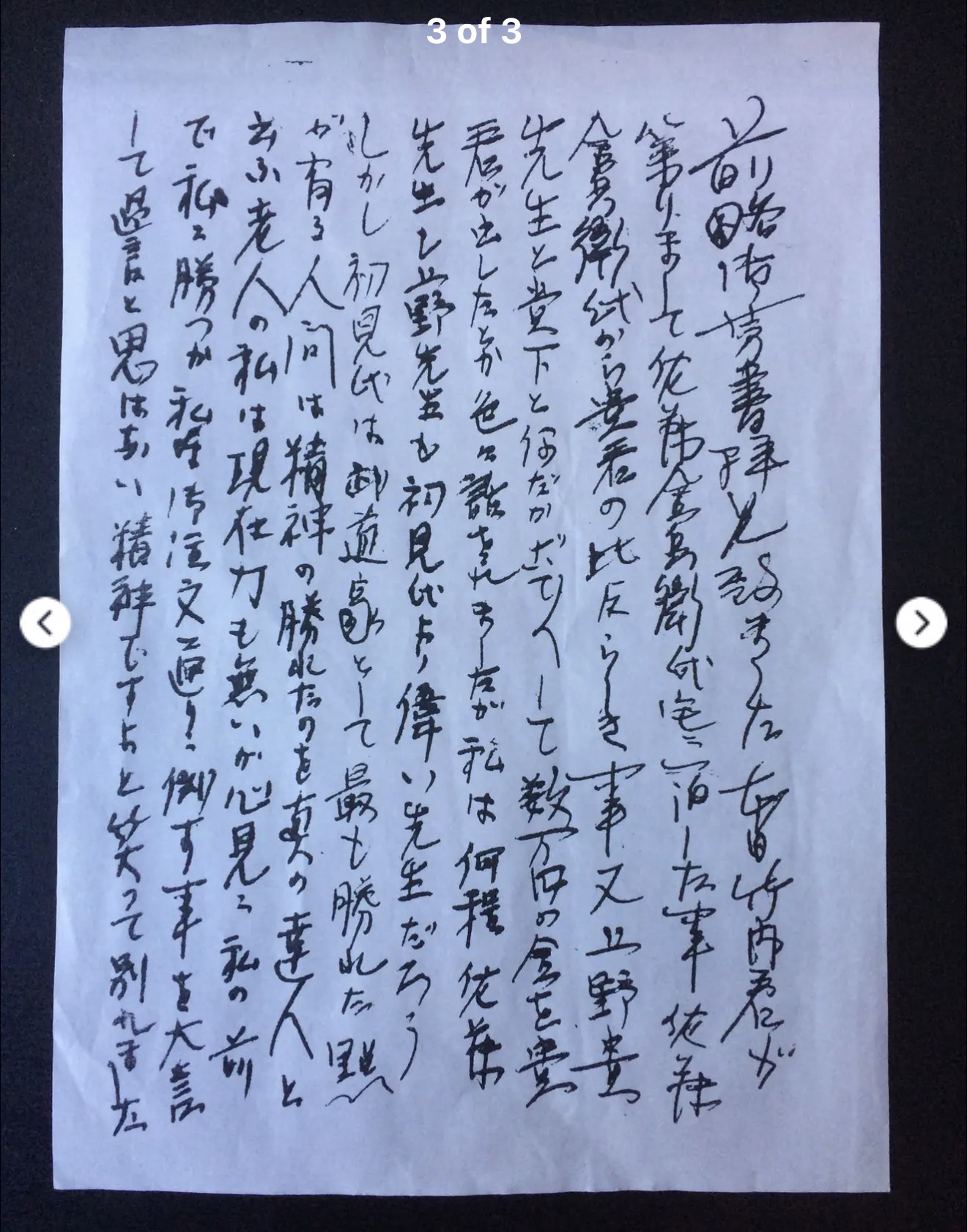
A few years ago when talking to Hatsumi Sense in his home he had mentioned he was tired of people asking him about Ueno Takashi and Sato Kinbei. He didn’t like the discussions that were going on regarding whether or not Takamatsu Sensei ever taught them or not. He asked that I show everyone via this postcard what Takamatsu Sensei really thought of them and how they compare to Hatsumi Sensei in Takamatsu Soke’s eyes. Obviously they had met with Takamatsu Sensei on many occasions and received training, but they were not on the same level as Hatsumi Sensei as a “Budoka” or martial artist.
Enjoy this translation of the attached photos of the letter, please note that Takamatsu Sensei’s way of writing and method of speech is very difficult to translate. His style is traditional but casual. To translate it literally will not make too much sense so I have taken the liberty to paraphrase it and make it easier to understand for the non-Japanese speakers.
Sean Askew
Bujinkan Kokusai Renkoumyo
Edited 12/16/2016 to include translation corrections by my old friend and training partner Mr. George
Ohashi. Big thanks!
Addressed to Hatsumi Sensei from Takamatsu Sensei.
Thank you for your letter. The other day, Mr. Takeuchi came to see me and he discussed about staying over at Sato Kinbei Sensei’s home. There he heard something like a criticism about you by Mr.Sato, that Ueno Takashi sensei and you had a kind of problem and you paid several tens of thousands of Yen. I explained to Mr. Takeuchi that I think Sato Sensei and Ueno Sensei are more renowned than yourself.
However, you Hatsumi Sensei, as a martial artist far out-do them both. A true master is the one who has the ability to win with the spirit. Even an old man like me, currently with no strength, can see into the hearts of those in front of me. When asked if I could win, I say I can take whomever I am ordered to do so!
I explained to Mr. Takeuchi that this is no exaggeration because of my spirit. We laughed as we parted ways.