
雜賀忍者 Saika Ninja (Page 136-139) from the book Bessho Rekishi Dokuhon Vol. 72 – Shinobi no Mono 132-nin Data File. Written by 鈴木眞哉 Suzuki Shinya (Historical Writer).
The Mysterious Kii Group Skilled in Fire Techniques and Seamanship
▽ Were There Ninjas Among the Saika?
One of the schools of ninjutsu is the 雜賀流 Saika-ryū School, said to have been transmitted in 紀州 Kii Province. The name suggests a clear connection to the 雜賀 Saika region. Besides this, Kii Province also had other ninjutsu schools such as the 紀州流 Kii-ryū School and the 根来流 Negoro-ryū School.

The Kii School, also called the 新楠流 Shinan-ryū School, is said to have been transmitted when 伊賀忍者 Iga ninjas, defeated in 織田信長 Oda Nobunaga’s attack on Iga in 1581 (天正九年 Tenshō 9), fled to 根来 Negoro. Some of these ninjas apparently escaped to Saika as well, so if this account is accepted at face value, all three schools would be part of the 伊賀流 Iga-ryū School lineage.
However, the credibility of this tradition is questionable, and it’s hard to believe that Saika (or Negoro) had no ninja-like techniques until taught by Iga. The need to approach enemies covertly or hide from them must have existed since ancient times.
It’s uncertain what the Saika School’s ninjutsu was like or whether it originated with the Saika people themselves. Nevertheless, techniques akin to ninjutsu must have existed in the Saika region for a long time.

Viewing ninjutsu from this perspective, it’s certain that ninja-like figures existed among the 雜賀衆 Saika-shū crowd. However, since such individuals inherently valued anonymity, it’s impossible to identify who among the Saika was a ninja or what position they held within the group.
Some claim the Saika crowd itself was a ninja collective, but that’s clearly not the case. In the 戦国時代 Sengoku period, Saika, in a narrow sense, referred to the lower reaches of the 紀ノ川 Kino River, and in a broader sense, included parts of present-day 和歌山市 Wakayama City and 海南市 Kainan City. The local landowning warriors there formed the Saika group.
That said, since Iga and Koga groups, also considered ninja collectives, were similarly gatherings of landowners, there might not have been a significant difference in that regard.

Iga and Koga are often imagined as groups wielding mysterious, superhuman techniques, but this seems largely a fabricated image created at desks in times of peace.
Looking at their actual actions, it’s evident they excelled in surprise attacks and guerrilla warfare, yet there are numerous instances where they were discovered by ordinary samurai and failed to infiltrate.
Nevertheless, while Iga and Koga landowners were known for ninja techniques, the Saika group’s strength lay in 鉄砲 teppō (firearms) and 水軍 suigun (naval forces). They used this power to challenge successive 天下人 tenka-bito (rulers). They fought Nobunaga for ten years and 豊臣秀吉 Toyotomi Hideyoshi for three, leading to their destruction, though some remnants plotted uprisings against 徳川家康 Tokugawa Ieyasu.

Evidence of the Saika group’s ninja-like traits can be confirmed from various angles. First, their occupational composition was highly complex. Given the era, agriculture was a given, but since that alone couldn’t sustain the economy, they engaged in 交易業 bōeki-gyō (trade), 海運業 kaun-gyō (shipping), 漁業 gyogyō (fishing), 製造業 seizō-gyō (manufacturing), and even mercenary work. This wasn’t always divided by specialization; individuals often took on multiple roles.
With such a lifestyle, it’s certain they mastered various skills and techniques, including 火術 kajutsu (fire techniques) and 操船術 sōsenjutsu (seamanship), which undoubtedly aided their ninja-like methods.

Their ninja-like nature becomes even clearer when examining their combat style. For instance, in 1577 (天正五年 Tenshō 5), when facing Nobunaga’s large army, the Saika group first advanced to 貝塚 Kaizuka in 泉州 Izumi Province (Osaka Prefecture) to set up camp. When Nobunaga’s forces approached, they retreated overnight, leaving the enemy empty-handed. This seems to have been a plan to lure Nobunaga’s army toward Kii Province, allowing allied 毛利勢 Mori-zei (Mori forces) to attack from behind.
Though the Mori forces’ arrival was delayed, the Saika group devised an ingenious defense for their base. They temporarily drained the Wakagawa River, buried numerous 壷や桶 tsubo ya oke (pots and barrels) in the riverbed, and then let the water flow back. Unaware, Nobunaga’s troops stepped into the river, got caught in the pots and barrels, fell into chaos, and were shot down one by one.
During this battle, Nobunaga was meticulous about maintaining communication between his main camp and frontline units, allocating many troops to secure Kino River crossing points. This indicates the Saika group’s guerrilla tactics frequently threatened Nobunaga’s 補給路 hokyū-ro (supply lines). Nobunaga’s forces, in response, burned houses and killed men and women indiscriminately across the region, likely out of frustration with the Saika group’s active guerrilla activities.
It’s well known that the Saika crowd possessed large quantities of firearms and excelled in their collective use. Individually, many were skilled marksmen, and a key trait of a marksman in that era was the ability to fire at close range whenever possible. A Saika figure, 佐武伊賀守 Satō Iga-no-kami, was notably skilled with a gun, and his personal records show he typically fired within ten 間 ken (about 18 meters).

To lure enemies or approach them, hiding was necessary, often using 硝煙 shōen (smoke), 地物 jimotsu (terrain), or disguises. These aspects undoubtedly reflected the Saika group’s ninja-like qualities.
In 江戸時代の小説 Edo-jidai no shōsetsu (Edo-period novels), a military advisor named 鈴木飛騨守 Suzuki Hida-no-kami is often depicted infiltrating enemy ranks to snipe Nobunaga. Though Hida-no-kami is fictional, he’s believed to be modeled on real figures like 鈴木源左衛門 Suzuki Genzaburō or Saika leader 鈴木孫一 Suzuki Sonichi. It’s plausible they engaged in similar actions.
Indeed, in the Battle of 石山城下 Ishiyama-jōka (Ishiyama Castle Town) in May 1576 (天正四年 Tenshō 4), Nobunaga was shot in the foot. This might have been the work of a Saika member who infiltrated his ranks.
Note: Actually Ryushin Yakushimaru, the founder of Kukishin-ryū, was born to Dōyu Shirōhōgan at Kumano-Hongu in Wakayama prefecture on January 1, 1318. So from this point on there was a family line with cunning and strategies that might have been involved here that explains what the author didn’t understand.
雜賀忍者 Saika Ninja (Page 136-139) from the book Bessho Rekishi Dokuhon Vol. 72 – Shinobi no Mono 132-nin Data File. Written by 鈴木眞哉 Suzuki Shinya (Historical Writer).
I could not find much information about this book, who wrote it or the publisher. It looks like it was published as a history book/magazine published monthly.
Being the 72’nd book I guess it has been around for many years, the web site jinbutsu.co.jp is dead so I don’t know much about the publisher.
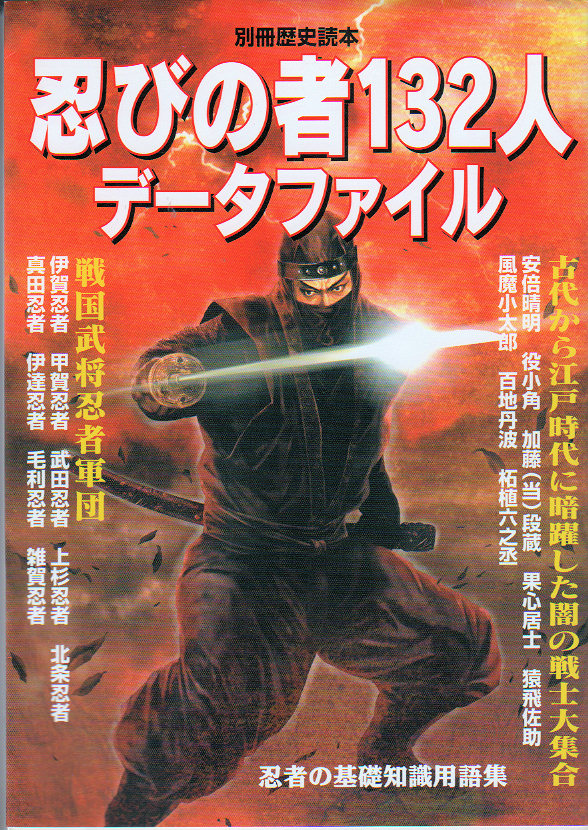
Published May 2001
228 pages
ISBN-10 : 4404027729
ISBN-13 : 978-4404027726

