
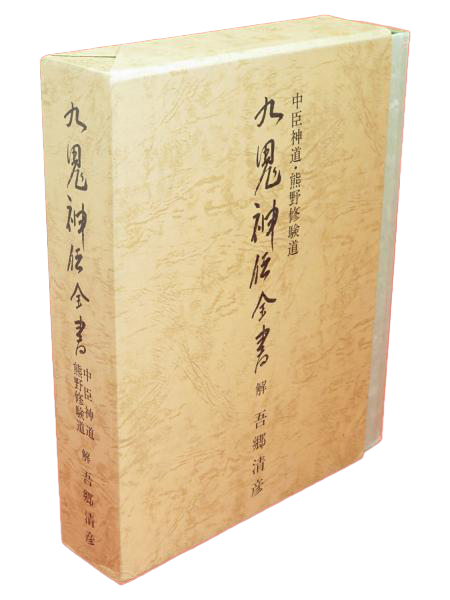
The 九鬼文書 Kuki Documents (Kukami Bunsho) are a collection of ancient Japanese texts (often classified as koshi kodensho or ancient historical transmissions) preserved by the Kuki family, tracing back to the 中臣 Nakatomi and 藤原 Fujiwara clans. They encompass cosmology, genealogy, Shinto rituals, martial arts, medicine, and historical narratives from creation to the Meiji era, originally in 神世文字 kamiyo moji (divine era script) and later transcribed into kanbun by 藤原不比等 Fujiwara no Fuhito. The texts have been annotated across generations, with additions noted via signatures 花押 kao.
The documents are not a single book but a corpus expanded over time. Based on the provided text, the core research compilation is 天津蹈鞴秘文遍 Amatsu-tatara-hibumi Hifumi (lit. “Secret Text of the Heavenly Bellows Hifumi”), a 36-volume work by 高松寿嗣 Takamatsu Toshitsugu, who added prefaces and commentary. This draws from the broader Kuki corpus, including historical, esoteric, and technical sections.
| In the 1930s, Takamatsu was permitted to copy all the scrolls from the Kuki family. During World War II, the original Kuki documents were destroyed in U.S. bombing raids. In 1947, Takamatsu returned a complete set of his copies to the Kuki family. Because the surviving documents cannot be carbon-dated earlier than 1947, many historians consider them forgeries. In all honesty, we don’t really know for certain. What is well documented is that Takamatsu copied genuine old scrolls that were subsequently destroyed in the war and then returned his copies to the family. |
External sources confirm the Kuki Documents as a multi-volume archive (e.g., ~55 volumes total across Shintoism, martial arts, and Shugendo; or grouped into 34 volumes under “国体歴史篇” [National Polity History], “神殿秘宝篇” [Shrine Treasures], and “兵法武教篇” [Military Strategy and Martial Teachings]). However, the text focuses on the 36-volume Amatsu-tatara-hibumi Hifumi, so the index below prioritizes that, structured hierarchically like a book table of contents. I’ve listed all named volumes/sections with original kanji, romaji (Hepburn style), volume counts, and brief notes from the text for context. Subsections are inferred where described.
天津蹈鞴秘文遍 Amatsu-tatara-hibumi Hifumi
Total Volumes: 36
Overview: A comprehensive exegesis of Kuki secrets, blending history, mysticism, martial arts, and healing. Divided into thematic volumes.
| Document Name | Volumes | Description |
|---|---|---|
| 九鬼秘文史論 Kuki Hifumi Shiron | 3 | Historical discourse on Kuki secret texts |
| 九鬼宗門神秘観静遍 Kuki Shūmon Shinpi Kanjō Hen | 2 | Mystical views of the Kuki sect ・The divination and prophetic rites of the great deity Konjin of the Ushitora direction) ・Esoteric yin-yang divination of the highest order, plus Shinto spells, curses, and binding/repelling rituals said to have been handed down directly from the storm god Susanoo |
| 九鬼神籬遍 Kuki Himorogi Hen | 3 | On temporary sacred enclosures ・Diagnosis of diseases, their causes, and medicinal treatments using herbs, minerals, etc. ・Methods of applying moxa cautery, detailed locations and functions of acupuncture/meridian points |
| 九鬼宝鏡秘伝 Kuki Hōkyō Hiden | 4 | Secret transmissions of the Kuki treasure mirror |
| 九鬼築城之巻 Kuki Chikujō no Maki | 1 | Castle construction |
| 九鬼鉄砲火薬遍 Kuki Teppō Kayaku Hen | 1 | Firearms and gunpowder techniques |
| 九鬼剣法秘想遍 Kuki Kenpō Hizō Hen | 1 | Secret swordsmanship contemplations |
| 九鬼薙刀秘勝遍 Kuki Naginata Hishō Hen | 1 | Secret naginata techniques |
| 九鬼柔体術活法遍 Kuki Jūtai Jutsu Katsuhō Hen | 3 | Flexible body arts and revival methods |
Subtotal: 3 + 2 + 3 + 4 + 1 + 1 + 1 + 1 + 3 = 19 volumes (text notes 36 total, implying additional unenumerated sections or expansions).
Broader Kuki Corpus References (From Annotations and Expansions)
The Kuki Documents include generational additions (e.g., by Kuki Takazane [九鬼隆真, 1st gen.], Yoshitaka [嘉隆, 9th], etc., and Fujiwara/熊野 collaborators like Takechimaro [武智麻呂], Morotada [師尹], etc.). Key foundational texts mentioned:
| Document Name | Notes |
|---|---|
| 中臣神司秘法遍之二 Nakatomi Kami Tsukasa Hihō Hen no Ni | Preface credits 天児屋根命 and descendants |
| 神史略 Shinshi Ryaku | Abbreviated divine history |
| 神代系譜 Kamiyo Keifu | Divine-era pedigrees |
| 天地言文 Tenchi Genbun | Words of heaven and earth |
| 国体歴史篇 Kokutai Rekishi Hen | 7-period cosmic-to-modern history |
| 神殿秘宝篇 Shinden Hihō Hen | Shrine secrets and treasures |
| 兵法武教篇 Heihō Bukyō Hen | Military strategy and martial teachings |
| 中臣神道 Nakatomi Shintō | Nakatomi Shinto rites |
| 大中臣神字 Ōnakatomi Shinji | Great Nakatomi divine script |
| 九鬼神字 Kuki Shinji | Kuki divine characters |
| 九鬼数学 Kuki Sūgaku | Kuki mathematics/esoterics |
| 鬼門祝詞 Kimon Norito | Ghost-gate incantations |
| 九鬼神流軍学・兵法 Kuki Shinryū Gun-gaku / Heihō | Kuki Shinryū military science & strategy |
| 武教・武術 Bukyō / Bujutsu | Martial teachings and arts |
| 九鬼華道・茶道 Kuki Kadō / Sadō | Kuki flower arrangement & tea ceremony |
| 宝鏡秘伝 Hōkyō Hiden | Treasure-mirror secrets |
| 九鬼神医法 Kuki Shin’i Hō | Kuki divine medicine |
| 鍼灸法・薬草 Shinkyū Hō / Yakusō | Acupuncture/moxibustion & medicinal herbs |
| 勾玉の伝承 Magatama no Denshō | Magatama lore |
| 熊野修験道 Kumano Shugendō | Kumano ascetic practices |
| 渡来秘法 Tōrai Hihō | Immigrant secret rites |
| 金剛秘法 Kongō Hihō | Vajra esoteric teachings |
Additional Thematic Sections (Secret Transmissions in Kuki Lore)
These are embedded across volumes, often as addenda:
- 中臣神道 (Nakatomi Shintō): Nakatomi Shinto rites.
- 大中臣神字 (Ōnakatomi Shinji): Great Nakatomi divine script.
- 九鬼神字 (Kuki Shinji): Kuki divine characters.
- 九鬼数学 (Kuki Sūgaku): Kuki mathematics/esoterics.
- 鬼門祝詞 (Kimon Norito): Ghost gate incantations.
- 九鬼神流軍学・兵法 (Kuki Shinryū Gun’gaku · Hōhō): Kuki divine flow military science and strategy.
- 武教・武術 (Bukyō · Bujutsu): Martial teachings and arts.
- 九鬼華道・茶道 (Kuki Kadō · Sadō): Kuki flower and tea paths.
- 宝鏡秘伝 (Hōkyō Hiden): Treasure mirror secrets (cross-referenced).
- 九鬼神医法 (Kuki Shin’i Hō): Kuki divine medicine.
- 鍼灸法・薬草 (Shin Kyū Hō · Kusuri Gusa): Acupuncture/moxibustion and herbs.
- 熊野修験道 (Kumano Shugendō): Kumano ascetic paths.
- 渡来秘法 (Toraibi Hihō): Immigrant secret rites.
- 金剛秘法 (Kongō Hihō): Vajra (diamond) esoterics.
This index captures all explicitly named elements from the text, formatted as a hierarchical table of contents. The 7-period historical framework (第一期: 造化準備時代 / Daiichi-ki: Zōka Junbi Jidai, etc.) spans the corpus but isn’t volume-specific. For deeper study, referenced books like Kiyohiko Wagō’s 九鬼神伝全書 (Kuki Shinden Zensho) compile further details.
